Medically reviewed by Taylor Hobson, M.D. | Reviewed July 2026
In my Tarzana office, I’ve had many similar conversations, where I sat across from someone who just heard the words “torn ACL” for the first time. The first question is almost always the same: “How long until I’m back?” I wish I could give a single number. I can’t, honestly, because ACL tear recovery depends on your graft, your goals, and how your knee responds along the way. What I can give you is the real timeline I walk my own patients through, stage by stage, so you know roughly what to expect.
Key Takeaways
- ACL tear recovery isn’t one countdown, it’s several overlapping phases, each with its own milestones.
- Surgery is often scheduled a few weeks after injury, not immediately, to let swelling and motion improve first.
- Patients regain full daily function well before they’re cleared for cutting or pivoting sports.
- Return to competitive sport is typically measured in months, often somewhere in the 9 to 12 month range, not weeks.
What Actually Happens to the Knee
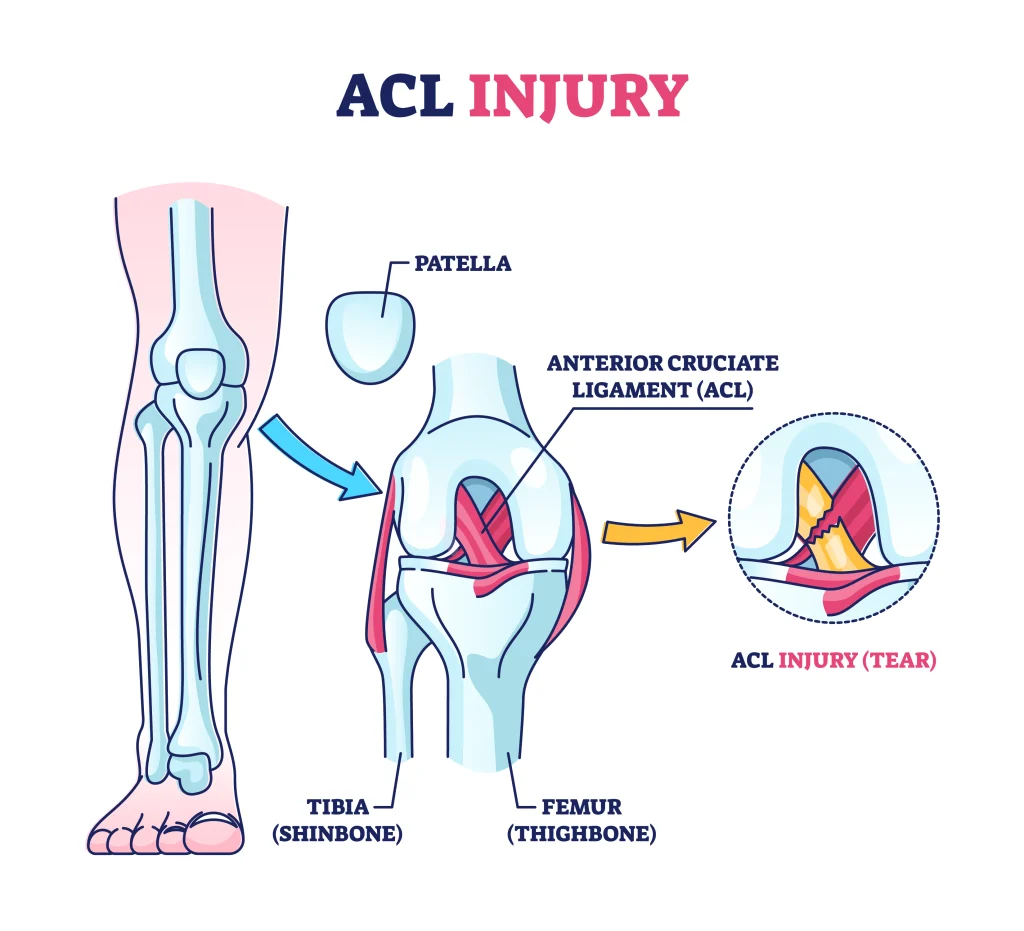
The ACL is the ligament that keeps your shinbone from sliding too far forward and rotating under your thighbone. Once it’s torn, it generally doesn’t heal back on its own. That’s the physical reason surgery gets recommended so often for active patients: without an intact ACL, the knee tends to give way during pivoting, cutting, or sudden stops, and that instability can chip away at the cartilage and meniscus over time.
Not everyone needs reconstruction. Patients whose activities are mostly straight-ahead, like cycling or using an elliptical, sometimes do well with focused physical therapy and no surgery at all. It really comes down to what your knee needs to do for you.
Why Surgery Isn’t Usually Immediate
Patients are often surprised that I don’t operate the week of injury. There’s a reason for that pause, generally somewhere in the range of a few weeks. Operating on a knee that’s still swollen and stiff raises the risk of a complication called arthrofibrosis, where the joint scars down and loses motion. So before I schedule surgery, I want to see the swelling settle and near-full range of motion return, usually with a short stretch of prehab focused on exactly that.
Waiting too long has its own downside, though. Beyond roughly three months, an unstable knee tends to put more wear on the meniscus and cartilage with every twist or pivot, so I try to find the window where the knee is calm enough to operate on but not so delayed that we’re inviting new damage.
A Word on Graft Choice
Part of what shapes an individual recovery timeline is which tissue gets used to rebuild the ligament, whether that’s the patellar tendon, the hamstring tendons, the quadriceps tendon, or, less commonly, donor tissue. Each option comes with its own trade-offs in strength, donor-site soreness, and how quickly it matures inside the knee. I walk through those trade-offs with every patient individually, since the right graft for a competitive teenage soccer player may not be the right graft for a recreational weekend hiker. For some guidance on what graft might be right for you, I like to guide my patients to the MOON Knee Group website.
The Recovery Timeline, Phase by Phase
Weeks 1 to 2: Protect and Calm the Knee
Right after surgery, the priority is controlling swelling and pain while protecting the graft. Most of my patients are on crutches and in a brace during this stretch, with gentle range-of-motion work starting almost immediately, since a stiff knee is harder to fix later than a slightly sore one.
Weeks 3 to 6: Rebuilding Motion
This is where physical therapy ramps up. The goals are full extension, progressively better flexion, and waking the quadriceps back up, since it tends to shut off after knee surgery in a way that surprises people. Walking without crutches often happens somewhere in this window, though it varies by graft type and how the knee is responding.
Months 2 to 4: Strength Phase
Once motion is solid, the focus shifts to strength and control. Stationary biking, closed-chain leg work, and balance training usually dominate this phase. Jogging in a straight line sometimes gets introduced toward the end of it, but only once strength benchmarks are met.
Months 5 to 8: Agility and Sport-Specific Work
This is where cutting, pivoting, and deceleration drills may get layered in, gradually and under supervision. It’s also where I lean on objective testing rather than how the knee “feels,” because a knee can feel ready well before it actually tests out that way.
Months 9 to 12: Return to Sport
For patients heading back to cutting or pivoting sports, this is the stretch where clearance typically happens, often somewhere between 9 and 12 months, sometimes later depending on graft maturity and strength symmetry between the two legs.
What I See in My Patients
The patients who struggle most aren’t usually the ones with a complicated tear. They’re the ones who feel good at month four and quietly start pushing past what their therapist and surgeon cleared them for. A knee can feel stable long before the graft has fully matured, and that gap between feeling ready and being ready is where I see most setbacks happen. I’ve also noticed that patients here in the Tarzana and greater Los Angeles area, many of whom are juggling club sports schedules or trying to get back for a specific season, feel that pressure especially hard. I understand the urgency. I just won’t let a schedule override what the knee is telling us. I’d rather clear a patient a few weeks later than watch them re-tear a graft because we rushed the last stretch.
My Approach to Treatment
I build every recovery plan around milestones, not dates. That means strength testing, hop testing, and honest conversations about where a patient’s knee actually stands, rather than handing someone a generic calendar on day one. When surgery is the right call, remember that it is only half the battle; proper and structured rehab is the other half. It is important to get into physical therapy early after surgery.
For patients who don’t need surgery, I still want you to participate in a structured strengthening program, because an ACL-deficient knee that’s well-supported by strong muscles around it can function surprisingly well for the right person.
Summary
ACL recovery isn’t about reaching a specific date on the calendar. It’s about restoring strength, movement, and confidence while allowing the reconstructed ligament time to heal. With the right surgical plan, dedicated rehabilitation, and objective return-to-sport testing, most patients can safely get back to an active lifestyle.
If you’ve recently torn your ACL, or you’re not sure whether what you’re feeling is actually an ACL injury, the most useful next step is a hands-on evaluation rather than more searching online. You can learn more about how I approach knee injuries on my site, review some of the questions I hear most often on my FAQ page, or go ahead and schedule a visit so we can get an accurate read on your knee and build a timeline that fits your situation.
Frequently Asked Questions
How long does ACL tear recovery really take from start to finish?
For patients returning to cutting or pivoting sports, the full arc from injury to clearance is often somewhere between 9 months and a year. Patients returning to lower-demand activities, like walking, cycling, or general fitness, may get there faster. Recovery times vary between patients.
Can I walk normally before I’m cleared for sports?
Yes, in most cases. Normal walking mechanics typically return well before sport clearance, often within the first couple of months, since sport clearance is measured against a much higher bar.
Do I need surgery for every ACL tear?
Not necessarily. It depends heavily on your activity goals and the stability of the knee day to day. That’s a conversation I have individually with every patient rather than applying a blanket rule.
Does the type of graft change how long recovery takes?
It can influence certain milestones, particularly early strength and donor-site soreness, though the overall return-to-sport window tends to be driven more by graft maturity and rehab progress than by graft type alone.