
Medically reviewed by Taylor Hobson, M.D. | Reviewed July 2026
If you’re dealing with frozen shoulder, you’re probably wondering two things: “Why is this happening?” and “When will it get better?” Those are fair questions, but the answers aren’t always what people hope to hear. Frozen shoulder develops gradually and typically resolves gradually as well, progressing through three distinct stages. Knowing what happens during each stage can make the process feel a little less uncertain.
Key Takeaways
- Frozen shoulder moves through three stages: freezing, frozen, and thawing, each with a different symptom pattern.
- The freezing stage is usually the most painful; the frozen stage is usually the stiffest.
- Many cases improve with non-surgical treatment; surgery is generally reserved for a smaller group of patients.
Stage One: Freezing
During this stage, pain is usually the most prominent symptom. It often starts as an ache that’s worse at night or with certain movements, then gradually intensifies as the shoulder becomes increasingly stiff and difficult to move. Range of motion starts to shrink here too, though patients may attribute that early stiffness to “guarding” against the pain rather than recognizing it as the start of the condition itself. This stage tends to last anywhere from about six weeks to nine months, though it varies quite a bit from person to person.
I generally tell patients that if their shoulder pain has been building for more than a few weeks without a clear injury behind it, especially if it’s disturbing sleep, it’s worth getting looked at during this window rather than waiting it out.
Stage Two: Frozen
Here’s where the name really earns itself. Pain often eases somewhat during this stage, but the stiffness becomes the main event. Reaching overhead, reaching behind the back, even simple things like fastening a bra or reaching for a wallet in a back pocket, can become genuinely difficult. This stage generally runs about four to six months, sometimes longer, and it’s usually the stage where patients get frustrated enough to seek a second opinion, since the pain has improved but the function hasn’t followed.
Stage Three: Thawing
The good news arrives here, but it’s gradual. Motion starts coming back, sometimes slowly enough that patients don’t notice week to week but can look back and see real progress month to month. This stage is typically the longest of the three, often running anywhere from about six months to two years before motion is fully, or nearly fully, restored. Patience matters enormously in this stage, since the temptation to force motion faster than the tissue is ready for can sometimes set recovery back rather than speed it up.
Why It Takes So Long
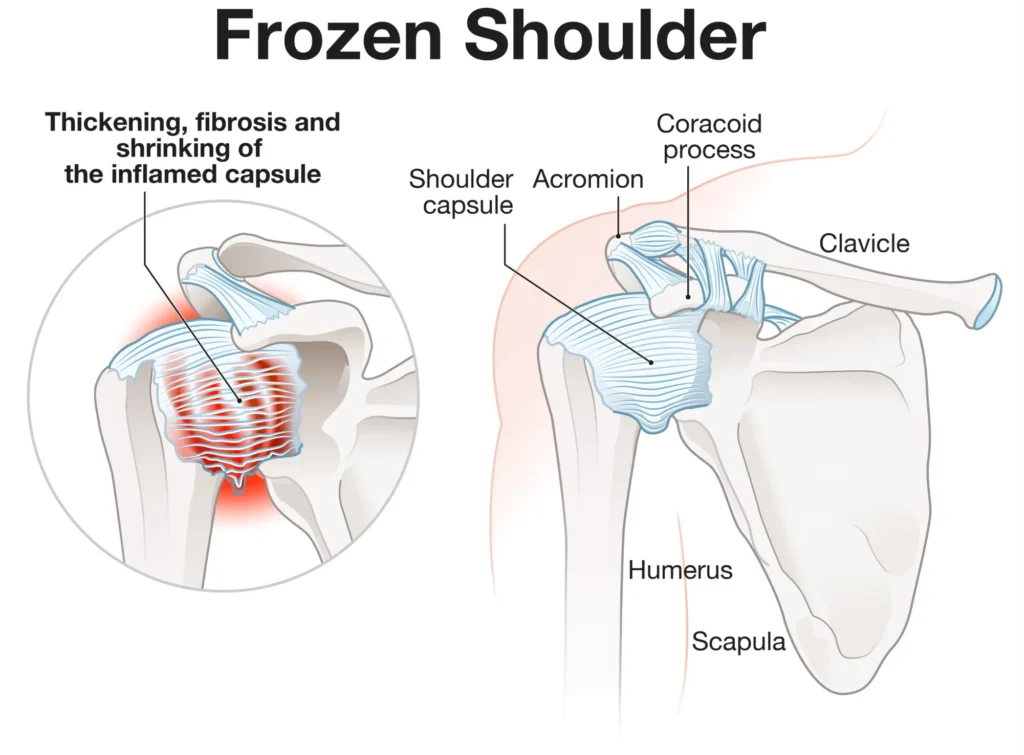
Frozen shoulder happens when the capsule surrounding the shoulder joint thickens and tightens, essentially shrink-wrapping the joint. That’s connective tissue we’re talking about, not muscle, and connective tissue simply remodels slowly.
Who Tends to Get Frozen Shoulder
It shows up most often in adults roughly between 40 and 60, and it’s more common in women than men, though I see it across a fairly wide range of patients. A shoulder that’s been immobilized for another reason, say after a fracture, a rotator cuff repair, or even a long stretch of favoring an injured arm, seems to be at higher risk of developing it, which is one reason I encourage gentle motion after any shoulder injury or surgery rather than keeping it completely still longer than necessary. Individuals with diabetes or thyroid conditions also seem to be more likely to develop frozen shoulder.
It can show up with no obvious trigger at all, what’s sometimes called idiopathic frozen shoulder, and those cases are just as real and just as limiting as the ones with a clear cause behind them.
How I Tell It Apart From Other Shoulder Problems
Frozen shoulder has a fairly distinctive fingerprint once you know what to look for: stiffness that limits motion both when the patient tries to move the arm themselves and when I move it for them during an exam. That second part matters, since conditions like a rotator cuff tear usually still allow a full passive range of motion, even if active motion is limited by pain. I’ll typically also order imaging, not because frozen shoulder shows up dramatically on a scan, but to rule out other things that can mimic it, like a rotator cuff tear or shoulder arthritis.
What I See in My Patients
The biggest misconception I run into, again and again, is the assumption that frozen shoulder should resolve in a matter of weeks like a typical strain. It doesn’t, and setting that expectation early saves patients a lot of unnecessary worry later. I also notice a pattern here in Tarzana and across the greater Los Angeles area: a lot of my patients are active, busy people who try to push through the frozen stage rather than adjusting their routine. While that’s an understandable instinct, pushing through significant pain generally doesn’t speed recovery and can leave people feeling more frustrated.
My Approach to Treatment
For most patients, I start with a combination of targeted physical therapy, activity modification, and sometimes a corticosteroid injection to take the edge off pain, particularly if we catch things during the freezing stage. Physical therapy needs to be dosed carefully here, gentle enough not to aggravate an inflamed capsule early on, then progressively more assertive as the shoulder moves into the frozen and thawing stages.
For the smaller group of patients whose stiffness isn’t budging with conservative care, particularly those stuck deep in the frozen stage, I may discuss options like manipulation under anesthesia or arthroscopic capsular release.
I also spend real time on expectation-setting at that first visit, since a patient who understands they’re looking at a year or more, rather than a few weeks, tends to stick with the program far better than one who’s blindsided by the timeline three months in. That consistency, more than any single treatment, tends to be what separates a smooth course from a frustrating one.
Summary
Frozen shoulder can be a frustrating condition, but understanding its natural progression can make the process feel much less uncertain. While recovery often takes many months, and sometimes longer, most patients improve with the right combination of time, physical therapy, and symptom management. The key is getting an accurate diagnosis early, setting realistic expectations, and following a treatment plan that’s appropriate for the stage you’re in.
If your shoulder pain and stiffness have been building for weeks without an obvious cause, don’t wait through all three stages before getting it looked at. You can schedule a visit so we can pinpoint exactly which stage you’re in and start you on the right treatment plan.
Frequently Asked Questions
Does frozen shoulder ever go away completely on its own?
In many cases, yes, though it can take well over a year and treatment usually speeds and smooths that process considerably.
Which stage is the best time to start treatment?
Earlier is generally better. Starting during the freezing stage often makes the overall course more manageable, though treatment can help at any stage.
Is frozen shoulder the same as a rotator cuff tear?
No, they’re different conditions, though they can sometimes be confused since both cause shoulder pain and limited motion. An exam helps distinguish between them.
Will I need surgery for frozen shoulder?
Most patients don’t. Surgery is generally reserved for cases that don’t respond adequately to non-surgical treatment over a reasonable trial period.
Can frozen shoulder come back after it resolves?
It’s uncommon in the same shoulder once it’s fully resolved, though it can occasionally develop later in the opposite shoulder.