Medically reviewed by Taylor Hobson, MD
The name “tennis elbow” causes more confusion than almost anything else in my practice. Most of the people I treat for it have never picked up a racket. Tennis elbow is an overuse injury of the tendons on the outside of the elbow. It shows up in painters, plumbers, parents carrying toddlers, and desk workers who type all day, just as often as it shows up in athletes. Getting the right tennis elbow treatment starts with understanding what’s actually happening in the tendon.
Key Takeaways
- Tennis elbow, medically known as lateral epicondylitis, is a tendon overuse injury, not a tear from a single traumatic event.
- Rest alone rarely resolves it. Targeted strengthening tends to matter more than avoiding activity altogether.
- Surgery is reserved for cases that fail a genuine trial of conservative treatment, usually after several months.
What Tennis Elbow Actually Is
Tennis elbow, or lateral epicondylitis, involves the tendons that attach the forearm’s extensor muscles to a bony bump on the outside of the elbow, called the lateral epicondyle. Repetitive gripping and wrist extension load those tendons over and over. Small amounts of microtrauma build up faster than the tissue can repair itself. Over time, the tendon develops small areas of degeneration rather than a clean tear.
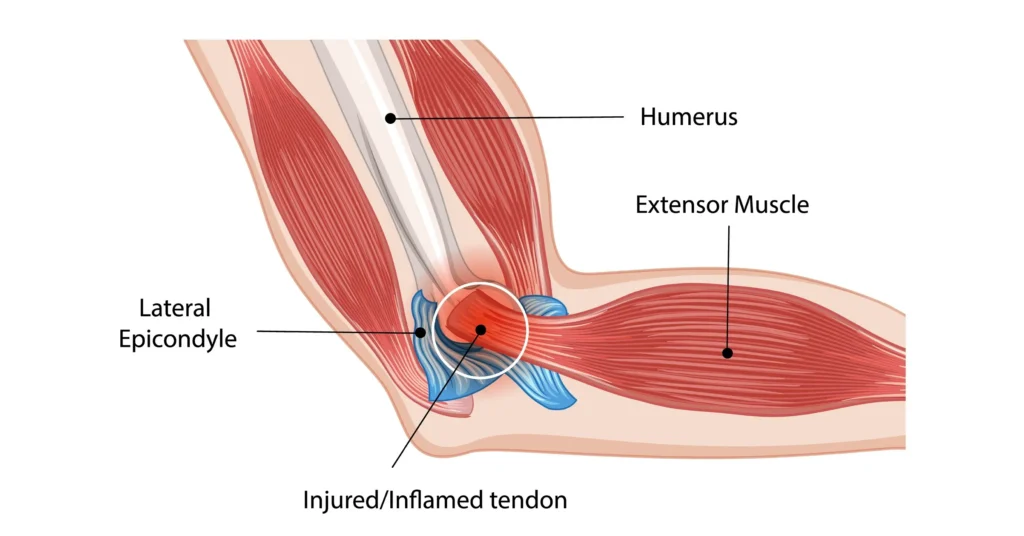
That distinction matters. This isn’t primarily an inflammatory problem. It’s a tendon that has started to break down under repetitive stress, and the treatment approach follows from that.
What Causes It
Any activity involving repetitive gripping, wrist extension, or forearm rotation can set this off. Racket sports are the obvious example. But plumbing, painting, carpentry, computer mouse use, and even repetitive lifting of a child can load the same tendons the same way. Poor technique, a grip that’s too small, or a sudden jump in activity volume all raise the risk.
Age plays a role too. Tennis elbow shows up most frequently in patients between their late thirties and mid-fifties. Tendon tissue at that age is naturally a bit less resilient than it was a decade earlier.
Symptoms Worth Paying Attention To
Pain on the outside of the elbow that worsens with gripping is the hallmark symptom. Shaking hands, turning a doorknob, or lifting a coffee cup can all trigger it once the tendon is irritated enough. Some patients also notice a weaker grip on the affected side.
Diagnosing the Problem
The diagnosis is usually clinical. A focused history and a physical exam that reproduces pain with resisted wrist extension can confirm it without imaging in most cases. X-rays occasionally rule out other causes of elbow pain, like arthritis or a loose body. An ultrasound or MRI can help when symptoms don’t follow the typical pattern, or when a patient isn’t responding to standard treatment.
Tennis Elbow vs. Golfer’s Elbow
These two conditions get lumped together constantly, and they’re not the same injury. Tennis elbow affects the tendons on the outside of the elbow and shows up with resisted wrist extension. Golfer’s elbow, or medial epicondylitis, affects the tendons on the inside of the elbow instead, and shows up with resisted wrist flexion. The treatment principles overlap quite a bit, but the exam findings and the exact location of pain point in opposite directions, which is why getting the diagnosis right matters before starting a rehab program.
Non-Surgical Treatment Options
The first line of tennis elbow treatment is almost always non-surgical, and it works for the large majority of patients. Activity modification reduces the aggravating load without necessarily requiring complete rest. A counterforce brace, worn just below the elbow, can offload the tendon during aggravating activities.
Physical therapy centered on eccentric strengthening tends to outperform generic rest-and-stretch programs. The goal is loading the tendon in a way that promotes healing rather than just avoiding pain. Some patients benefit from platelet-rich plasma injections, which use the body’s own healing factors to stimulate repair. Results vary, and this option is generally discussed on a case-by-case basis.
Preventing a Repeat Flare-Up
Once symptoms calm down, the next question is usually how to keep them from coming back. Grip size matters more than most people expect. A racket, tool, or golf club grip that’s slightly too small forces the forearm tendons to work harder than they should. Warming up the forearm before repetitive activity, and building in regular breaks during long stretches of typing or manual work, both reduce the cumulative load that starts this problem in the first place.
When Surgery Becomes the Right Conversation
Surgery is not the first, second, or usually even third step in tennis elbow treatment. It’s reserved for patients who’ve completed a genuine trial of conservative care, typically six months or more, without meaningful improvement. Lateral epicondylitis debridement removes the degenerated tendon tissue. It can be performed arthroscopically or through a small open incision, depending on the specifics of the case.
Recovery after debridement is gradual, not immediate. Most patients spend a short period in a brace or splint before starting a structured range-of-motion and strengthening progression. Return to full grip strength and unrestricted activity typically takes a few months rather than a few weeks. The exact pace depends on how long the tendon was symptomatic before surgery, and how disciplined the post-operative rehab program is.
What I See in My Patients
The pattern I run into most often isn’t a patient who hasn’t tried anything. It’s a patient who’s tried the wrong things, in the wrong order, for months on end. Someone rests for two weeks, feels a little better, goes back to full activity, and the pain returns just as fast. I often see this with weekend athletes and tradespeople here in the San Fernando Valley who don’t have the luxury of stopping work while they heal.
My sports medicine background shapes how I think about this condition. I approach it the way I’d approach any overuse tendon injury in an athlete: load management first, targeted strengthening second, injections used strategically rather than as a repeated crutch. Patients who follow through on a real eccentric strengthening program, not just stretching, are the ones I see get back to full activity fastest.
My Approach to Treatment
I don’t reach for surgery early with this condition, and I tell patients that directly at the first visit. My starting point is almost always activity modification paired with a structured eccentric strengthening program. The evidence behind that combination is stronger than the evidence behind rest alone. I use a brace selectively, mainly for patients who need to keep working or playing through a physical job or season while the tendon recovers.
When a patient has genuinely failed months of conservative care, I discuss debridement, and I walk through exactly what recovery looks like before we schedule anything.
Summary
Tennis elbow treatment works best when it follows a clear sequence: activity modification, targeted eccentric strengthening, selective use of bracing and injections, and surgery only after a real trial of conservative care has failed. It’s a tendon overuse problem, not a one-time injury, which is why quick fixes and short bursts of rest rarely solve it on their own. If you’ve been dealing with elbow pain for more than a few weeks and haven’t tried a structured strengthening program yet, that’s the logical next step before considering anything more invasive. Schedule a visit and we can build a plan that fits your activity level.
Frequently Asked Questions
Do I need to stop all activity to heal tennis elbow?
Not usually. Complete rest often isn’t necessary, and it can even slow recovery compared to a program that modifies aggravating movements while keeping the tendon active in a controlled way.
How long does tennis elbow typically take to resolve?
Many cases improve significantly within a few months of consistent treatment. Some cases take longer, especially when the tendon has been irritated for a long time before treatment starts.
Is surgery usually needed for tennis elbow?
No. The large majority of patients improve with non-surgical treatment. Surgery is reserved for the smaller group who don’t improve after a genuine, extended trial of conservative care.
Can tennis elbow come back after treatment?
It can, especially if the activity or technique that caused it in the first place doesn’t change. Addressing the underlying mechanics, not just the pain, is usually the key to keeping it from recurring.