
Medically reviewed by Taylor Hobson, M.D. | Reviewed July 2026
A meniscus tear is one of the most common knee injuries I see in my practice, and one of the first questions patients ask is whether they’ll need surgery. The answer is rarely as simple as yes or no. Some tears do well with activity modification, physical therapy, and time, while others are unlikely to improve without an operation. The decision depends on several factors, including the type of tear, where it’s located, your symptoms, your age, and what you expect your knee to be able to do. Understanding those factors can help you make a more informed decision about the best treatment approach.
Key Takeaways
- Not every meniscus tear needs surgery. Location, tear pattern, and blood supply all factor into the decision.
- Tears in the outer, well-vascularized zone of the meniscus have a chance of healing or being repaired. Tears in the inner zone, where blood supply is poor, usually can’t be repaired.
- Age, activity level, and whether the knee is unstable all weigh heavily into which path makes sense.
Why Location Matters So Much
The meniscus isn’t uniformly supplied with blood. The outer third, sometimes called the red zone, has a decent blood supply, which means tears there have a chance of healing on their own or responding well to surgical repair. The inner two-thirds, the white zone, has little to no blood supply. Tears in that region generally can’t knit back together, repaired or not, which is why they’re more often trimmed away rather than stitched.
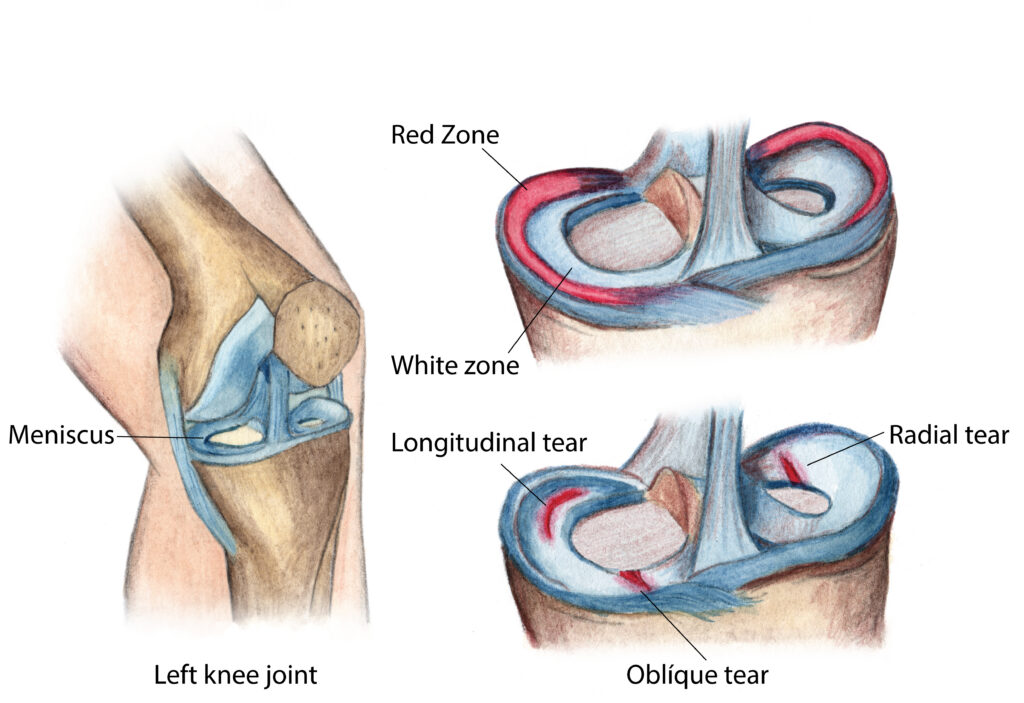
So, when a patient asks me whether their tear can be fixed, my honest first answer is: it depends on exactly where it is, not just that it exists.
How a Meniscus Tear Usually Announces Itself
Most patients describe a specific twisting moment, often during sports, though I also see plenty of degenerative tears that show up gradually with no clear injury at all, usually in patients who are a bit older. Swelling, a catching or clicking sensation, and pain along the joint line are the classic signs. Some patients notice their knee locking, unable to fully straighten, which is often a sign that a torn piece of meniscus is physically getting caught between the bones. A thorough exam, combined with an MRI when the picture isn’t clear from the exam alone, is usually enough to confirm both the diagnosis and the tear pattern.
When Non-Surgical Treatment Makes Sense
Small, stable tears, particularly in older patients or those with degenerative tears related to wear and tear rather than a single injury, often do reasonably well without surgery. Physical therapy focused on strengthening the muscles around the knee, activity modification, and sometimes an injection to calm inflammation can be enough to get someone back to comfortable function. I lean toward this route when the knee isn’t locking or giving way and the pain is manageable, since surgery always carries some risk that’s worth avoiding when it isn’t necessary.
When Surgery Enters the Picture
Locking, catching, or a knee that gives way are the signals that usually push me toward surgery, along with tears that haven’t responded to a reasonable trial of conservative care. From there, the type of surgery depends heavily on the tear itself.
Partial Meniscectomy (Trimming)
This is the more common of the two procedures. The torn, unstable tissue gets trimmed away, leaving the healthy meniscus in place. It’s a relatively quick recovery, generally somewhere in the range of a few weeks before returning to normal activity, sometimes faster for lower-demand patients.
Meniscus Repair
When the tear sits in a repairable zone and the patient is a good candidate, usually younger and active, stitching the tear back together tends to be the better long-term choice, even though it asks more of the patient up front. Recovery can be longer, often several months, since the tissue genuinely needs time to heal rather than just settle down. Return to higher-demand sports after a repair often runs closer to six to nine months, considerably longer than after trimming.
Why Age and Activity Level Matter
A meniscus tear in a 19-year-old athlete and a meniscus tear in a 65-year-old with some underlying arthritis are, practically speaking, two different conversations, even if the MRI report uses similar language. In younger, higher-demand patients, I may lean harder toward preserving meniscus tissue through repair when the tear pattern allows it, since they’ll be asking that knee to hold up for decades of activity. In older patients, especially where degenerative changes and early arthritis are already present in the joint, repair often isn’t realistic since the tissue itself is more worn, and a well-executed meniscectomy paired with physical therapy tends to serve them better.
What I See in My Patients
The pattern I notice most is patients pushing for the “quicker” option, meniscectomy, when they’d actually be better candidates for repair. I understand the instinct. Nobody wants a longer recovery. But trimming away meniscus tissue that could have been saved raises the long-term risk of arthritis in that knee, and I’ve watched that trade-off play out poorly for patients who prioritized a faster return over the knee’s long-term health. Here in the Tarzana and greater Los Angeles area, I see a lot of weekend athletes and working professionals who want to get back on the court or the field fast, and that’s exactly the group I spend the most time discussing this trade-off with.
My Approach to Treatment
I start with a thorough exam and imaging to understand exactly where the tear sits and what kind of pattern it follows, since that’s really the deciding factor more than any single symptom. If there’s a reasonable case for the tear healing or responding to repair, I’ll usually recommend giving that path a chance, because preserving as much healthy meniscus as possible tends to pay off years down the road. When trimming is genuinely the better option, whether because of tear location or because repair simply wouldn’t hold, I don’t hesitate to recommend it. The goal is always the option that serves the knee long-term, not just the fastest way back to activity.
Summary
Not every meniscus tear requires surgery. Whether an operation is recommended depends on the tear’s location, pattern, severity, your symptoms, and your activity level. Tears in the outer portion of the meniscus, where blood supply is better, may heal with conservative treatment or be repaired, while tears in the inner portion may require surgery because they cannot heal effectively.
If your knee is catching, locking, or just not settling down the way you’d expect, the location and pattern of the tear matter more than any general rule you’ll find online. You can read more about my approach to knee injuries and treatment or schedule an evaluation so we can look at your specific tear and figure out the option that actually fits your knee.
Frequently Asked Questions
Can a meniscus tear heal without any treatment at all?
Small, stable tears in the outer, well-vascularized zone sometimes do improve with rest and physical therapy alone, though this isn’t guaranteed and depends on the specific tear.
How do I know if my tear can be repaired instead of trimmed?
It comes down to imaging and, often, direct visualization during arthroscopy. Location within the meniscus and the pattern of the tear are the primary factors.
Is it ever okay to just wait and see with a meniscus tear?
Sometimes, particularly with mild symptoms and no locking or instability. That said, waiting too long with a tear that’s causing mechanical symptoms can sometimes make the eventual surgery more complicated, so it’s worth getting evaluated rather than guessing.
Can a meniscus tear turn into arthritis if I don’t treat it?
An untreated, unstable tear may accelerate wear on the cartilage over time, which is one reason mechanical symptoms like locking or a knee that gives way shouldn’t be ignored indefinitely.