
Medically reviewed by Taylor Hobson, M.D.
A rotator cuff tear is one of the most common reasons patients end up in my office, whether they’re reaching for a baseball to pitch or just reaching for a dish on the top shelf. I see it across every age group and activity level, from high school athletes to grandparents, and the questions are usually the same: did I tear something, do I need surgery, and how long until I’m back to normal? In this post, I want to break down what a rotator cuff tear actually is, what tends to cause one, and how I decide on the right treatment for my patients in the San Fernando Valley.
Key Takeaways
- A rotator cuff tear involves damage to one or more of the four muscles and tendons that stabilize and power the shoulder joint.
- Tears can happen suddenly, from a fall or a heavy lift, or develop gradually from years of repetitive overhead motion and normal aging.
- Not every rotator cuff tear needs surgery. Many partial tears and some small, chronic full-thickness tears respond well to physical therapy and injections.
- Larger tears, acute traumatic tears, and tears in younger or more active patients tend to do better with earlier surgical repair.
What Is a Rotator Cuff Tear?
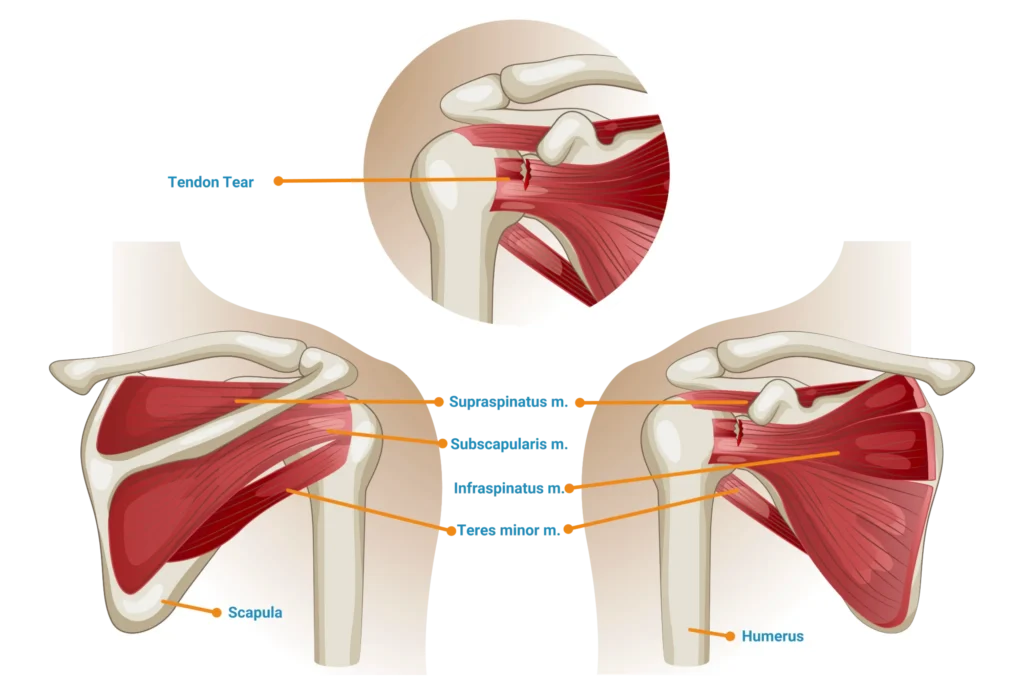
The rotator cuff is a group of four muscles and their tendons that wrap around the head of the upper arm bone, holding it securely in the shoulder socket while powering many of the arm’s movements. Those four muscles, the supraspinatus, infraspinatus, teres minor, and subscapularis, work together to keep the joint centered and to drive lifting and rotation. A rotator cuff tear occurs when one or more of those tendons partially or completely separates from the bone, or tears somewhere along its length.
Tears generally fall into two categories. A partial-thickness tear damages some of the tendon fibers but leaves the tendon at least partly attached. A full-thickness tear goes all the way through the tendon, and in more severe cases, the tendon pulls away from the bone entirely.
What I See in My Patients
In my practice, a rotator cuff tear tends to show up in a few recognizable patterns. There’s the patient in their fifties or sixties who didn’t fall or get hurt in any specific way. The shoulder just started hurting and getting weaker over months, and by the time they see me, imaging shows a tear that’s likely been building for years. There’s the more active or athletic patient, sometimes someone I’ve followed since covering them as a team physician, who felt something tear during a specific lift, throw, or fall and wants to know right away whether surgery is in their future. And there are patients in physically demanding jobs around the San Fernando Valley, contractors, movers, landscapers, whose cuff simply wears out faster from years of repetitive overhead work.
What I’ve learned treating all three groups is that the story behind the tear tells me almost as much as the imaging does. A sudden, traumatic tear in an otherwise healthy tendon behaves differently than a tear that developed slowly inside a tendon that’s been degenerating for years, and that distinction shapes how I talk about treatment from the very first visit.
Causes and Risk Factors
A rotator cuff tear can develop in two main ways. An acute tear happens suddenly, often from falling onto an outstretched arm, lifting something too heavy, or a sudden jerking motion that overloads the tendon. A degenerative tear develops gradually, usually from years of repetitive overhead activity, such as throwing, swimming, or overhead work, combined with the natural effects of aging on tendon tissue.
Age plays a role here. Tendon quality tends to decline over time, even in people who haven’t had any specific injury, which is part of why a rotator cuff tear becomes more common after age fifty. Repetitive overhead activity, whether from sport or occupation, can accelerate that process by placing ongoing stress on tendons that are already losing some of their resilience.
Symptoms of a Rotator Cuff Tear
Symptoms vary somewhat depending on the size and pattern of the tear, but a few patterns show up fairly consistently:
- A deep, aching pain in the shoulder, frequently worse at night or when lying on the affected side.
- Weakness when lifting the arm, reaching overhead, or rotating the shoulder, which can make everyday tasks like reaching for a seatbelt or putting on a jacket noticeably harder.
- A catching, popping, or grinding sensation with certain shoulder movements.
Not every rotator cuff tear is painful. Some degenerative tears, particularly in older patients, cause more weakness than pain, and a portion of tears are discovered incidentally on imaging done for an unrelated reason.
My Approach to Treatment
Every rotator cuff evaluation in my office starts the same way: a detailed history, a hands-on physical exam, and an honest conversation about what the shoulder can and can’t do right now. From there, I typically order an MRI to confirm the size, location, and quality of the tear, since that information changes the conversation significantly.
Treatment isn’t one-size-fits-all. Partial-thickness tears and tendinopathy often respond well to physical therapy, activity adjustments, and a well-placed corticosteroid injection, and I’m comfortable giving that approach real time to work. Small, chronic, full-thickness tears in lower-demand patients can also do well without surgery in many cases. Where I tend to push toward earlier surgical repair is with larger tears, acute traumatic tears, and tears in younger or more active patients, because tendon and muscle quality tend to decline the longer a significant tear goes unrepaired, and that decline can limit how well a later repair holds up.
When surgery is the right path, I typically perform arthroscopic rotator cuff repair, using small incisions and a camera to reattach the tendon to bone while minimizing disruption to the surrounding muscle. Massive or chronic tears sometimes call for more advanced repair techniques, and in patients with significant arthritis or a cuff that can’t be meaningfully repaired, reverse shoulder replacement may be considered.
Recovery After Rotator Cuff Repair
Recovery after a rotator cuff repair takes time, and I tell patients that upfront because it’s one of the most common surprises I see. Most patients wear a sling for several weeks after surgery, commonly in the four-to-six-week range, to protect the repair while the tendon begins healing back to bone. Physical therapy typically starts with gentle, protected motion early on and progressively adds strengthening over the following months as the repair matures.
In my experience, the patients who do best are the ones who treat the early weeks seriously instead of rushing back to normal activity. Tendon healing doesn’t follow the same timeline as pain relief. Your shoulder may feel ready well before the tendon actually is, which is exactly when re-tears tend to happen. A full return to heavy lifting, overhead sport, or physically demanding work can take several months, and I’d rather see a patient progress gradually than push too soon and risk the repair.
Summary
A rotator cuff tear isn’t a single diagnosis with a single treatment. The right plan depends on whether the tear is partial or full-thickness, how it happened, how large it is, and what you need your shoulder to do. Many tears improve with focused physical therapy and time, while others genuinely benefit from surgical repair, especially when the tear is large or the tendon quality is declining. If shoulder pain or weakness has been limiting you for more than a few weeks, the next right step is a shoulder-specific exam, not more guessing. Schedule a visit, and we’ll get an accurate picture of what’s going on and build a plan around it.
Frequently Asked Questions
How do I know if I have a rotator cuff tear or just a shoulder strain?
A strain typically improves within a week or two of rest and activity modification, while a rotator cuff tear often causes persistent weakness, night pain, or symptoms that don’t meaningfully improve. That being said, the only reliable way to tell the difference is a physical exam, sometimes paired with imaging.
What happens if a rotator cuff tear goes untreated?
Some tears stay stable for years without causing major problems, but others gradually enlarge, and tendon and muscle quality can decline the longer a significant tear goes unaddressed. That decline can make a later repair more complicated, which is part of why I recommend getting a tear evaluated rather than ignoring it indefinitely.
How successful is rotator cuff repair surgery?
Many patients regain meaningful strength and a significant reduction in pain after rotator cuff repair, particularly when the tear is addressed before it becomes massive or chronic. That said, outcomes vary based on tear size, tissue quality, and how closely a patient follows their rehabilitation plan.